
Antigone knew exactly what she believed she had to do. The harder question was whether she was willing to act when the consequences were real.

Fear does not always arrive when you are confused.
Sometimes it arrives after the confusion is over.
You know the conversation you need to have. The boundary you need to set. The truth you need to say out loud. The change you can no longer keep postponing.
You have thought it through.
Probably more than once.
And somewhere beneath all the rehearsing, second-guessing, and waiting, you already know what you believe you should do.
The problem is not knowing.
The problem is what doing it might cost.
Maybe someone will be angry. Maybe you will disappoint people you care about. Maybe you will fail. Maybe the next step will close a door you cannot easily reopen.
Fear notices all of that.
Sometimes it should. Fear can warn us about real danger, real consequences, and choices we have not thought through carefully enough.
But fear can also make another demand:
Do not move until you are certain.
So you wait to feel more confident. More prepared. Less afraid.
Sometimes that feeling comes.
Sometimes it doesn’t.
And eventually the question changes.
It is no longer simply:
Am I afraid?
It becomes:
Does fear get to make the decision?
More than two thousand years ago, a young woman named Antigone faced a version of that question. She knew what she believed she had to do.
She also knew what it might cost her.
If you’re skimming
Courage does not require fear to disappear before you act.
Antigone’s story asks what happens when conscience, authority, and consequence collide.
Fear can be important information without becoming the voice that makes the decision.
Antigone knew the cost
In Sophocles’ Antigone, courage does not begin with uncertainty about what is right.
It begins with a command.
Antigone’s two brothers, Eteocles and Polynices, have killed each other in a struggle for Thebes. The new king, Creon, orders that Eteocles be buried with honor.
Polynices, who fought against the city, is to be left unburied.
Anyone who defies the order will be put to death.
For Antigone, the decree creates a collision between two kinds of obligation. Creon speaks for the authority of the state.
Antigone believes she owes a deeper duty to her brother, to her family, and to the sacred customs surrounding burial.
She understands the law.
She understands the punishment.
And she decides to bury her brother anyway.
What makes the moment powerful is not that Antigone believes nothing bad will happen. She does not expect Creon to forgive her or persuade herself that the danger has been exaggerated.
She acts with a remarkably clear view of the consequences.
When she is caught, she does not deny what she has done.
Creon gives her opportunities to retreat, but Antigone refuses to pretend that obedience would have been the same thing as doing what she believed was right.
The tragedy that follows is devastating.
And Sophocles does not make the conflict simple.
Creon has reasons for defending civic authority. Antigone’s certainty has its own severity.
That complexity matters.
Antigone is not a story telling us that defiance is always courageous, or that conviction automatically makes us right.
It asks a harder question:
What happens when fear of the consequences collides with something we believe we cannot betray?
Antigone understands what human authority can do to her.
She simply decides that fear will not be the only thing allowed to speak.
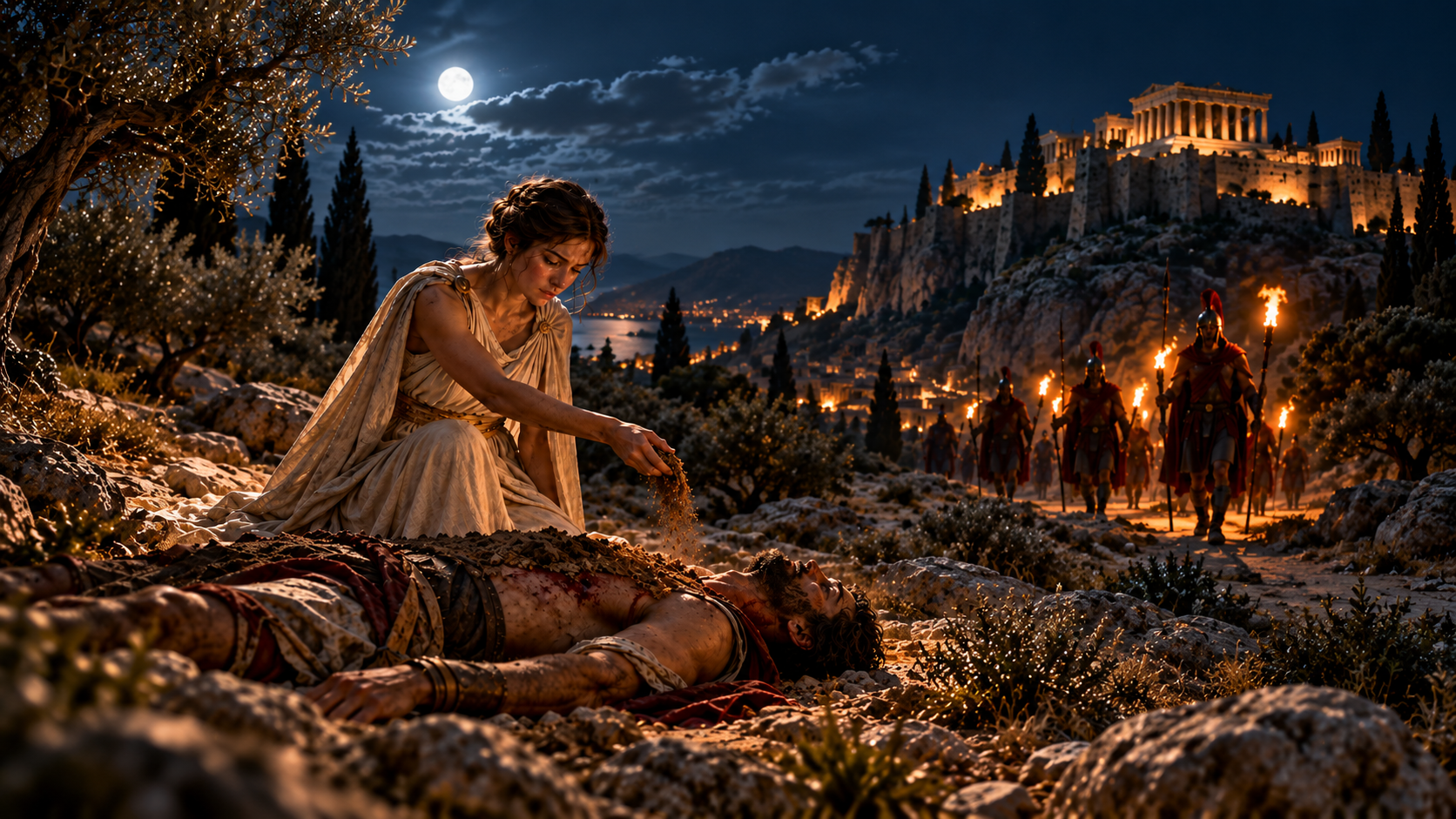
Fear is information. It is not instruction.
It is tempting to turn courage into a personality trait.
Some people are brave. Others are not.
But most of us know that is not how it feels from the inside.
The same person can be fearless in one part of life and deeply afraid in another. You may be able to handle a crisis at work and still avoid one difficult conversation at home.
You may take enormous professional risks and freeze when the risk is disappointing someone you love.
Fear changes shape depending on what matters to us.
That is why courage is not really about becoming less afraid.
It is about deciding what role fear gets to play.
Fear can tell you that something matters. It can alert you to danger, consequences, uncertainty, or the possibility of loss.
That information deserves attention.
But information is different from instruction.
The trouble begins when fear quietly becomes the decision-maker.
You stop asking, What do I believe is right?
You start asking, What choice will make me feel safest?
Those are not always the same question.
Antigone’s story is extreme because tragedy makes the stakes impossible to ignore. Most of us will never face anything close to her choice.
But the pattern is familiar.
You know you should speak.
You know you should leave.
You know you should ask.
You know you should begin.
And fear immediately starts building a case for why now is not the time.
Sometimes it is right.
Sometimes it is simply afraid.
Courage begins when you can listen to fear carefully without automatically obeying it.
Not because consequences do not matter.
Because sometimes something else matters more.

What courage looks like now
Courage rarely looks dramatic from the outside.
More often, it looks like speaking when it would be easier to stay quiet.
Making the decision everyone else has been avoiding.
Taking responsibility when there is no guarantee the outcome will go your way.
Sometimes courage is simply being the person who moves first.
Not because you are certain.
Because you have decided that fear will not be the only thing allowed to lead.
That shift can change more than one decision.
Once you stop waiting to feel fearless, you become more willing to say what you mean, choose what matters, and accept that some worthwhile actions come with discomfort attached.
Courage does not remove uncertainty.
It changes who is in charge of what happens next.
PRACTICE
Let fear speak. Then decide who leads.
Think of one action you already suspect you need to take.
Not the biggest decision of your life. Just something you have been postponing because acting on it makes you uncomfortable.
Write down the fear as plainly as you can.
What am I afraid will happen if I do this?
Be specific. Rejection. Conflict. Embarrassment. Failure. Disappointing someone. Losing something familiar.
Then ask:
What is this fear trying to protect me from?
There may be something useful in the answer. Fear sometimes notices consequences that deserve attention.
Now ask the harder question:
If fear were not allowed to make the final decision, what would matter most here?
Your values. Your responsibility. Your integrity. The person you want to become.
Finally, complete this sentence:
I can be afraid and still choose to ________.
You do not need to eliminate the fear before you move.
You only need to decide whether it gets the final vote.
A final thought
Courage is often imagined as a feeling.
But most of the time, it is a decision made before the feeling arrives.
Fear may still be there. The consequences may still be real. You may still wish the choice were easier.
And you can move anyway.
Sometimes courage is not becoming unafraid.
Sometimes it is refusing to let fear be the only voice that gets a vote.
Not sure which crossroads you’re standing at?
The Crossroads Compass can help you identify the kind of challenge you may be facing now—Control, Choice, Courage, Release, or Renewal—and point you toward the Saga & Sage path that fits best.