
So what can you control? Arjuna faced that question on a battlefield thousands of years ago.
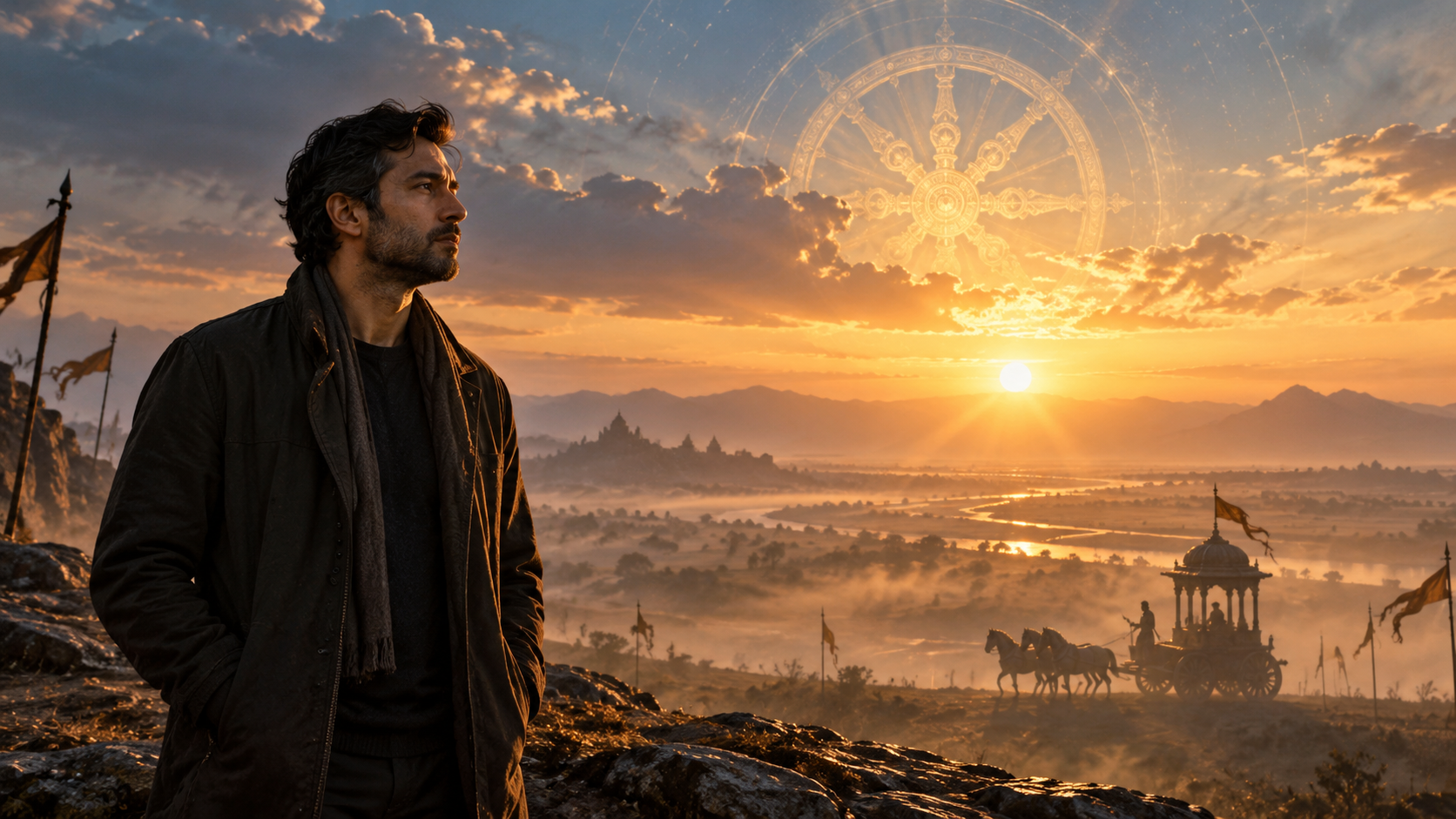
You can do everything right and still not get the outcome you want.
You can prepare carefully, make the best decision you know how to make, work harder than everyone around you—and still watch events move in a direction you did not choose.
That is one of the hardest truths to accept.
Because most of us don’t simply want to influence what happens. We want some assurance that if we make the right choices, the right result will follow.
But life rarely makes that bargain.
The promotion goes to someone else. The medical test comes back differently than you hoped. Your child makes a decision you cannot make for them. A relationship changes. A business struggles. An election goes the other way. Someone you love does not respond the way you imagined they would.
So we plan harder. Worry more. Replay conversations. Run scenarios. Try to anticipate every possibility.
It feels like responsibility.
Sometimes it is.
And sometimes it is an attempt to control what was never ours to control.
Thousands of years ago, the Bhagavad Gita placed a warrior named Arjuna in an impossible situation and asked a question that still feels uncomfortably modern:
What do you do when you are responsible for your actions—but cannot control what those actions will produce?
That is where Arjuna’s story begins.
If you’re skimming
You control your effort, choices, preparation, and response—not the final outcome.
Arjuna’s crisis is not really about whether he can guarantee success. It is about how to act when certainty is impossible.
Peace comes from taking responsibility for what is yours without trying to possess what never was.
The battlefield
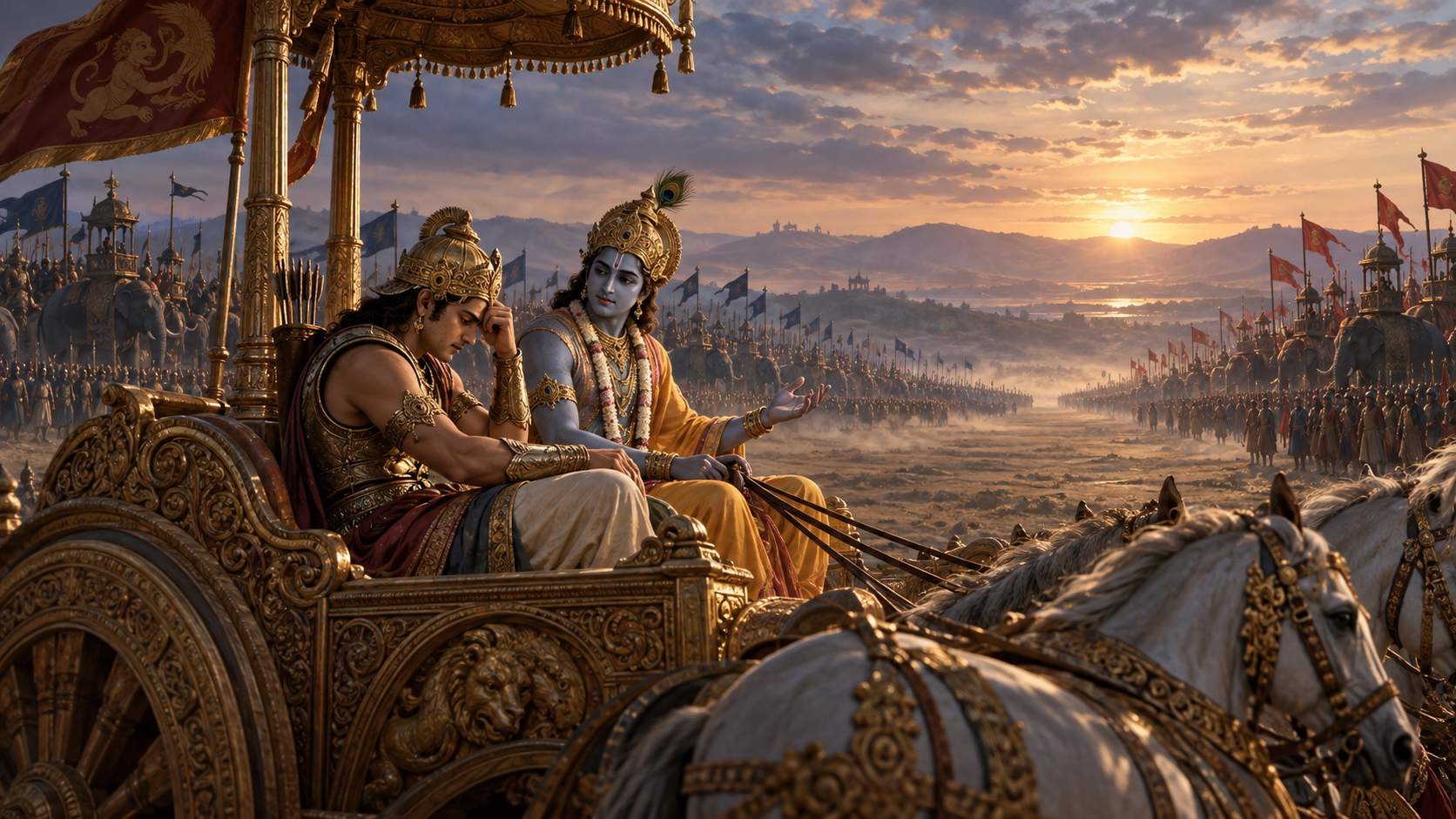
Arjuna is a warrior standing between two armies.
The battle is about to begin. The people facing him are not strangers. They are teachers, relatives, friends, and men he has known for years. Whatever happens next will carry consequences he cannot fully predict or control.
And suddenly, Arjuna does not want to fight.
His body gives way. His confidence disappears. The role he has trained for all his life no longer feels simple or clear.
He can see reasons to act.
He can also see reasons not to.
That is what makes the moment so powerful. Arjuna is not paralyzed because he is weak. He is paralyzed because the stakes are enormous and every possible outcome carries loss.
So he turns to Krishna, his charioteer and guide.
What follows in the Bhagavad Gita is not a lesson in getting the result you want.
It is a lesson in learning how to act when the result is not yours to command.
Krishna tells Arjuna, in essence, that he is responsible for his action—but not entitled to control the fruits of that action.
That distinction is easy to say and difficult to live.
Because most of us quietly attach ourselves to outcomes all the time.
We don’t just want to prepare well for the interview. We want the job.
We don’t just want to have the honest conversation. We want the other person to respond the way we hope.
We don’t just want to do good work. We want recognition.
We don’t just want to make the best decision we can. We want proof that it was the right one.
Arjuna’s dilemma exposes the trap in that thinking.
If we make our peace dependent on the result, then our peace is always vulnerable to forces outside our control.
Krishna does not tell Arjuna to become indifferent.
He does not tell him that outcomes do not matter.
He tells him to act with care, discipline, and integrity—while releasing the demand that reality produce the ending he prefers.
That is a very different kind of control.
It is not control over what happens.
It is control over how you meet what happens.
And that is where the story becomes useful.
What control really means
Arjuna’s problem is not that he has no power.
He has training. Judgment. Skill. Responsibility. He can choose whether to act, how to act, and what kind of person he will be while acting.
What he cannot choose is the ending.
That distinction is uncomfortable because modern life often trains us to blur the line between influence and control.
If I work hard enough, I should succeed.
If I explain myself clearly enough, they should understand.
If I make the right decision, it should turn out well.
If I prepare for every possibility, nothing should surprise me.
But none of those promises are actually available to us.
Effort matters.
Preparation matters.
Skill matters.
Judgment matters.
They increase the odds of a good outcome.
They do not guarantee one.
The problem begins when we start treating a good process as a contract with reality.
Then every setback feels like evidence that we failed.
Every uncertainty becomes something to solve.
Every person becomes someone we need to persuade.
Every future becomes something we feel responsible for controlling.
That is exhausting.
And it can make us worse at the very things we actually can control.
We become less present in the conversation because we are trying to manage the response.
Less thoughtful in the decision because we are obsessing over whether it will prove correct.
Less effective in our work because we are spending energy rehearsing outcomes that have not happened.
Arjuna’s lesson is not passivity.
It is precision.
Be precise about what belongs to you.
Your preparation.
Your effort.
Your conduct.
Your choices.
Your willingness to act with integrity even when the result remains uncertain.
And then be equally precise about what does not belong to you.
Other people’s reactions.
Timing.
Luck.
Circumstances.
The final outcome.
That does not make uncertainty disappear.
It makes it lighter to carry.

What letting go looks like now
Letting go of control does not always look peaceful in the moment.
Sometimes it looks like sending the email.
Having the conversation.
Closing the laptop.
Walking out of the room.
Turning down the offer.
Admitting that someone else may never understand your decision.
The important part is not that the uncertainty disappears.
It is that you stop arranging your life around the hope that you can make everyone else behave differently.
You stop measuring every choice by whether it produces the response you wanted.
You stop treating another person’s anger, disappointment, approval, or silence as proof that you chose correctly or incorrectly.
That is what makes the return possible.
You can still care deeply about the outcome.
You simply stop handing it authority over your next move.
And once you do that, something changes.
The energy that was spent managing other people comes back to you.
You can use it for your own work.
Your own judgment.
Your own next step.
That is what letting go looks like now.
Not indifference.
Not defeat.
Freedom to act without needing the world to cooperate first.
PRACTICE
Draw the Circle Smaller
When anxiety starts to rise, we often make the circle of responsibility too large.
We begin carrying things that are not actually ours to carry: other people’s reactions, future outcomes, timing, luck, whether someone agrees, whether the plan works exactly as hoped.
Try this instead.
Take a piece of paper and divide it into two columns.
Mine to control
My preparation
My effort
My choices
My words
My conduct
My response
Not mine to control
Other people’s decisions
Whether I am liked or understood
Timing
Luck
The final result
Then take the situation that is worrying you and sort each part of it into one column or the other.
Do not use this exercise to convince yourself that the outcome does not matter.
It probably does.
The point is to stop spending your best energy on the part you cannot command.
Ask yourself:
What is the next action that is fully mine?
Then do that.
Let the rest remain uncertain.
That is not surrender.
It is discipline.
A final thought
You are responsible for your actions.
You are not responsible for controlling the entire world around them.
That sounds obvious until something matters deeply.
Then the mind starts bargaining: If I prepare enough, explain enough, anticipate enough, work enough, maybe I can make this come out the way I need it to.
Sometimes you can influence the result.
You can never own it.
Arjuna’s challenge is to act fully without demanding certainty in return.
That is a difficult kind of freedom.
It asks you to care deeply, prepare seriously, choose carefully—and still leave room for life to unfold beyond your control.
You do not have to stop wanting a particular outcome.
You only have to stop making your peace depend on it.
Then add the same Compass CTA structure we used on Dante:
Not sure which crossroads you’re standing at?
The Crossroads Compass can help you identify the kind of challenge you may be facing now—Control, Choice, Courage, Release, or Renewal—and point you toward the Saga & Sage path that fits best.