
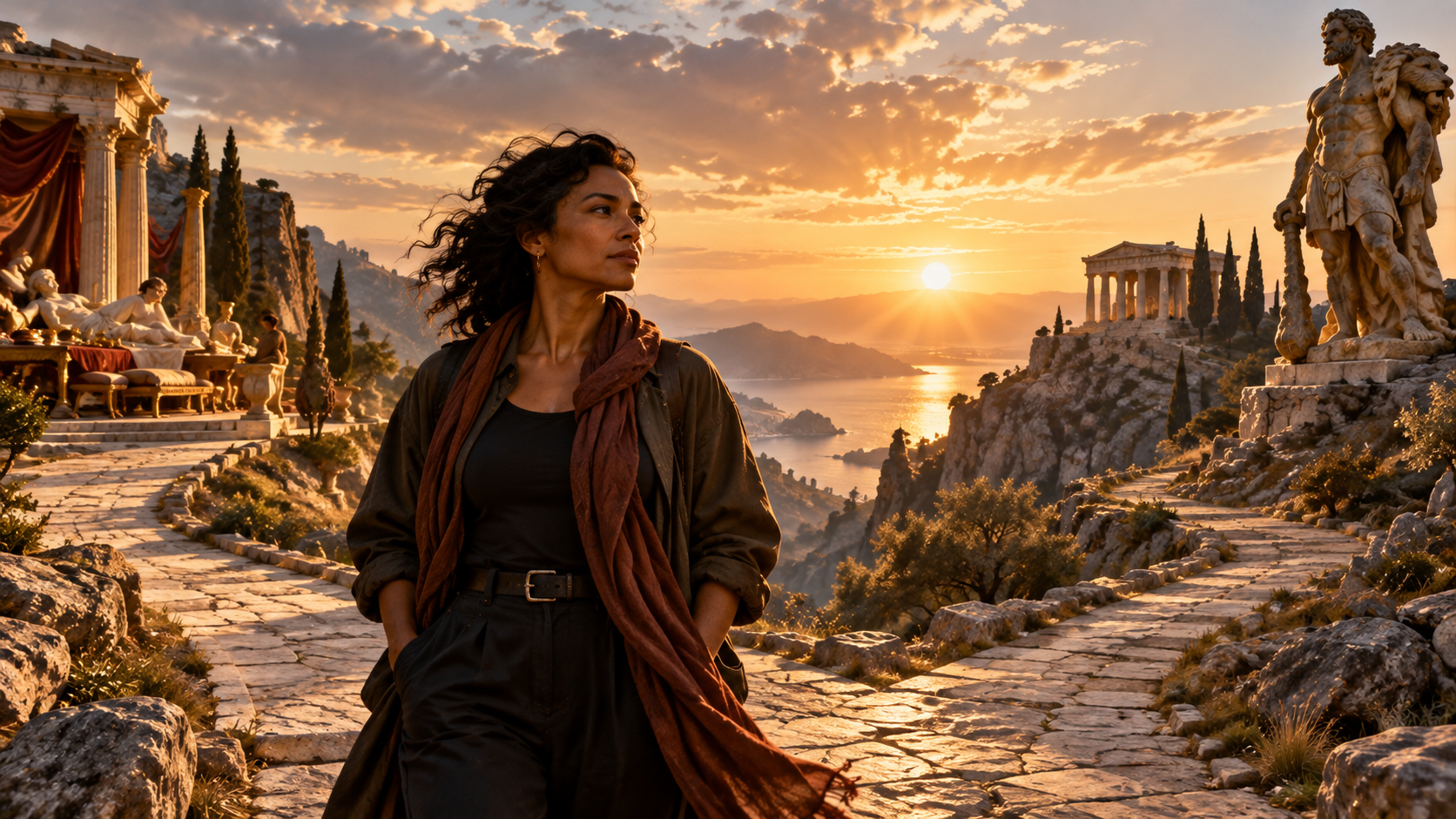
Hercules once stood at a crossroads with two very different paths before him. The harder question wasn’t which road looked better. It was which life he was willing to choose.
Some choices are hard because the options are bad.
Others are hard because both paths could work.
That is often worse.
You can imagine a future down either road. You can see the benefits of both. You can also see what each choice might cost.
So you compare.
Then compare again.
You ask people you trust. You make lists. You run scenarios in your head. You wait for some feeling of certainty to arrive.
Sometimes it does.
Sometimes it doesn’t.
And eventually the real question changes.
It is no longer simply:
Which choice is right?
It becomes:
Which life am I willing to choose?
That question sits at the heart of an old story about Hercules standing at a crossroads.
Before the labors. Before the lion skin. Before he became the hero people remember.
He was simply a young man deciding what kind of life he wanted to live.
If you’re skimming
Hard choices are often difficult because each path asks you to give something up.
Hercules at the crossroads is really a story about identity: the life you choose shapes the person you become.
When certainty is unavailable, values can become a better guide than prediction.
The crossroads
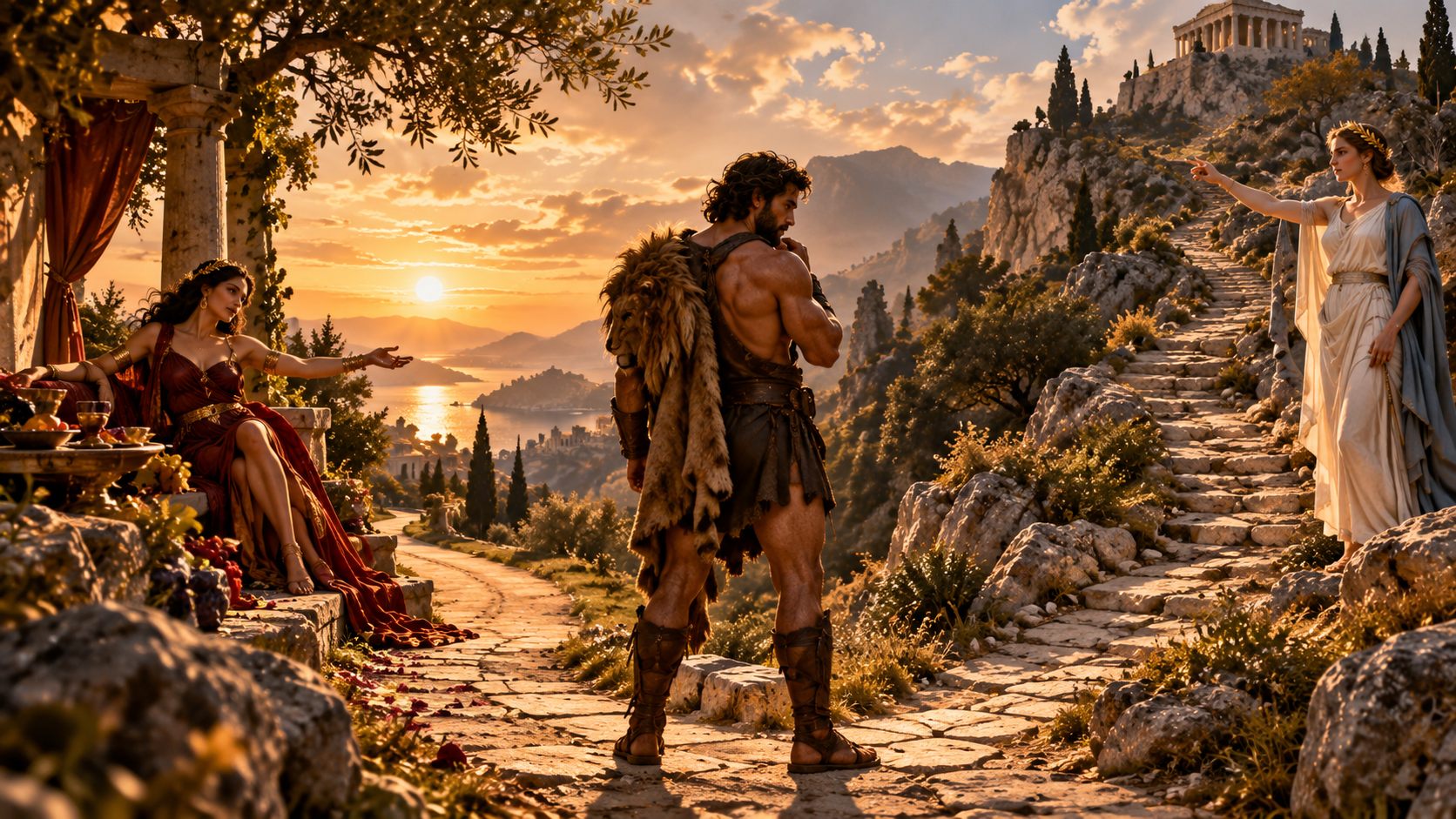
In the ancient Greek story often called The Choice of Hercules, the hero is still young.
He has not yet become the Hercules of the twelve labors. There is no lion skin, no legend, no certainty about who he will become.
He is alone, thinking about the life ahead of him.
And then two paths appear.
Each is represented by a figure offering him a different kind of future.
One promises ease.
Pleasure. Comfort. Recognition without much sacrifice. A life organized around avoiding hardship and taking what feels good when it appears.
The other offers something much less immediately attractive.
Work.
Discipline.
Effort.
Difficulty.
But also honor, strength, purpose, and the possibility of becoming someone worthy of respect.
The story is sometimes reduced to a simple moral: Hercules chooses virtue instead of vice.
But that makes the choice sound easier than it is.
The easier road is appealing precisely because it is easier.
The harder road does not arrive with proof that the struggle will be worth it. It simply asks Hercules to decide what kind of person he wants his life to produce.
That is what makes the story useful.
Most important choices do not present themselves as good versus evil.
They look more like:
Security or possibility.
Comfort or growth.
Staying or leaving.
Achievement or time.
The familiar life or the uncertain one.
And sometimes both paths contain something you genuinely want.
That is why we get stuck.
We keep searching for the choice that will let us keep everything.
The career move without the disruption.
The new life without the risk.
The relationship without the sacrifice.
The freedom without the uncertainty.
The reinvention without giving up the identity we have already built.
But crossroads rarely work that way.
Choosing one path means not choosing another.
Something is gained.
Something is surrendered.
And no amount of analysis can completely remove that truth.
Hercules does not solve the crossroads by predicting which future will make him happiest.
He chooses according to the person he wants to become.
That shifts the question.
Instead of asking:
Which option guarantees the best outcome?
He is effectively asking:
Which path asks me to become someone I respect?
That is a harder question.
It is also often a more useful one.
Because prediction has limits.
You cannot know exactly how a new job will unfold.
You cannot know whether the move will be everything you hoped.
You cannot know whether staying will eventually feel wise or regretful.
You cannot know how the people around you will change.
But you can know something about the values you want your decision to express.
Courage.
Loyalty.
Freedom.
Responsibility.
Curiosity.
Stability.
Growth.
Service.
Adventure.
There is no universal correct answer.
Hercules’ road was his.
Your road may be different.
The point of the story is not that everyone should choose the harder option.
Difficulty alone does not make a choice meaningful.
The point is that when certainty fails, character can become a compass.
Sometimes the question is not:
Which road is safest?
or even:
Which road will work?
Sometimes it is:
Which road is most aligned with the person I want to be?
That does not make the decision painless.
But it can make it clearer.
What the crossroads means now
Most of us do not get two figures appearing beside the road to explain our options.
We get spreadsheets.
Pros-and-cons lists.
Conversations with friends.
Late-night searches.
A dozen browser tabs.
And a mind that keeps circling the same question because neither choice feels completely safe.
That is the modern crossroads.
The mistake is assuming that more analysis will eventually produce certainty.
Sometimes it will.
Often it will not.
Because some decisions cannot be solved like equations.
They involve competing values.
A job may offer security but less freedom.
A move may offer possibility but take you farther from people you love.
Staying may preserve stability while leaving part of you wondering what might have happened if you had gone.
Leaving may open a new life while requiring you to surrender one that still contains things you value.
Neither path has to be wrong.
That is what makes the choice difficult.
We often respond by trying to predict the future with greater precision.
Which option will make me happier?
Which one will I regret less?
Which one will work?
Those are reasonable questions.
They are also questions no one can answer completely.
The future refuses to give guarantees.
So another kind of question becomes useful.
Not:
Which choice removes all risk?
But:
What value would this choice express?
Maybe one path expresses courage.
Another expresses loyalty.
One protects stability.
Another creates room for growth.
One honors a commitment you made.
Another honors a truth you can no longer ignore.
There is no universal hierarchy that tells you which value should win.
That is why meaningful decisions are personal.
The purpose of clarifying your values is not to make the choice painless.
It is to understand what you are actually choosing between.
Sometimes what looks like a decision about careers is really a decision about freedom.
What looks like a decision about moving is really about belonging.
What looks like a financial decision is really about security.
What looks like a scheduling problem is really about what deserves your limited time.
Once you see the values underneath the options, the crossroads often becomes clearer.
Not easy.
Clearer.
And there is one more uncomfortable truth in Hercules’ story:
Choosing creates identity.
We like to imagine that we first discover exactly who we are and then make decisions that reflect it.
But often it happens the other way around.
We become ourselves partly through the choices we keep making.
The conversations we avoid.
The risks we take.
The promises we keep.
The opportunities we decline.
The things we decide are worth struggling for.
A single choice may not define you.
But repeated choices leave a trail.
Eventually, that trail becomes a life.
So when every option feels imperfect, perhaps the goal is not to find the path with no cost.
Perhaps it is to choose the cost that belongs to the life you actually want to build.
And then walk.

What choosing looks like now
Most of us do not face a dramatic crossroads with two goddesses standing beside us. We face quieter ones.
A city you could move to.
A relationship you could deepen or leave.
A job you have outgrown.
A version of yourself you can no longer keep pretending to be.
Usually, the hardest part is not that the options are invisible. It is that choosing one life means letting another go.
That is why choice can feel so heavy.
Not because you are weak. Because you understand that decisions have consequences.
They shape identity. They close certain paths so others can begin.
But this is also why choice matters.
A chosen life may not be a perfect life. It may still include loss, uncertainty, and second-guessing. What it gives you is alignment.
You stop scattering your energy across ten imaginary futures. You begin inhabiting one real one.
And often, peace does not arrive before the decision.
It arrives after you finally make it.
PRACTICE
Choose the door you can walk through
If you are standing at a crossroads, do not ask yourself to solve your entire life today.
Just try to get honest.
Take a few quiet minutes and write your way through these questions:
What decision have I already been circling?
Which option feels more true, even if it also feels harder?
What am I afraid I will lose if I choose?
What might I gain in clarity, energy, or self-respect?
If I stopped trying to keep every door open, which door would I actually walk through?
You do not need absolute certainty.
You need enough courage to stop pretending indecision is neutrality.
Sometimes not choosing is still a choice. It is a choice to remain where you are.
A final thought
Hercules does not become Hercules by keeping his options open.
He becomes himself by choosing.
That is the real challenge at the crossroads.
Not to find the path with no cost.
Not to find the path that guarantees applause.
Not to find the path that removes all doubt.
Only to choose the one you can respect yourself for walking.
The door does not open because you feel perfectly ready.
It opens because, at some point, you decide to step through.
Not sure which crossroads you’re standing at?
The Crossroads Compass can help you identify the kind of challenge you may be facing now—Control, Choice, Courage, Release, or Renewal—and point you toward the Saga & Sage path that fits best.