
Your crossroad · 2 of 5
Choice
When every choice feels like the wrong one.
For the moments when every path has a cost, and you keep waiting for certainty before choosing.
You may be waiting for certainty before choosing a path that cannot provide it.
Choice becomes difficult when every direction seems to close off another possibility. You may keep weighing, researching, reconsidering, or imagining all the ways a decision could go wrong—hoping that eventually one option will reveal itself as unquestionably right.
YOUR ANCIENT STORY: HERCULES AT THE CROSSROADS
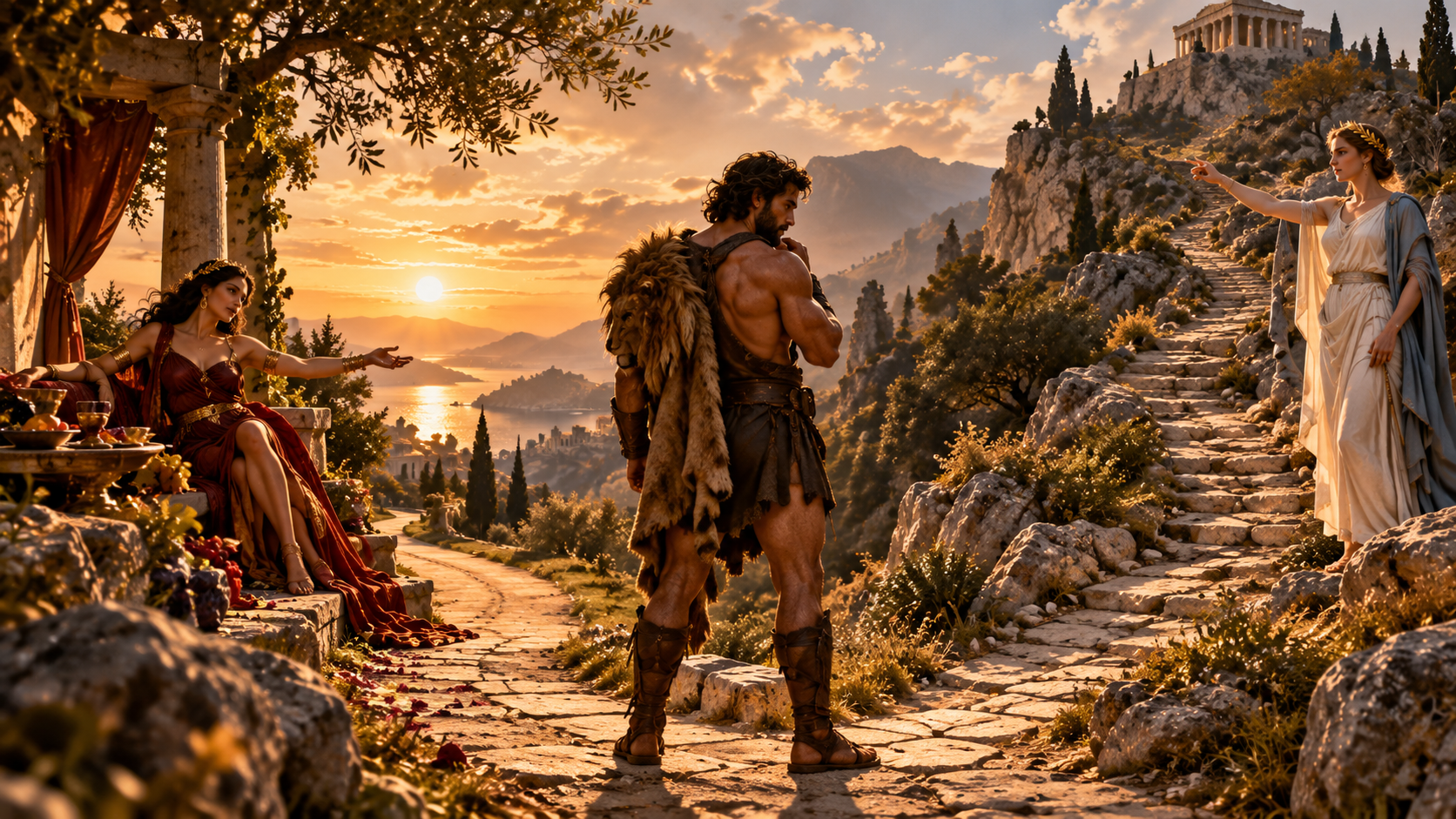
A young Hercules encounters two women offering different ways to live. One promises a life of ease and pleasure. The other offers a more demanding path of virtue and purpose.
His story asks a question we still face today: When no choice feels easy, what matters enough to guide us?
WHAT CHOICE CAN FEEL LIKE
You are not short on options. You are short on certainty.
The longer you stand at the crossroads, the more consequential every road can begin to feel. Choosing one direction means leaving another unexplored, and that can make even a good decision feel like a loss.
You keep gathering information long after you have enough to decide.
You imagine the paths you are not choosing more vividly than the one in front of you.
You want a decision to feel certain before you are willing to make it.
THE ANCIENT STORY
Hercules could not choose both roads.
In the ancient story of Hercules at the Crossroads, the young hero is confronted with two different paths. One promises ease and immediate pleasure. The other asks more of him—effort, discipline, and a life shaped by what he values.
Neither path comes with proof of how his life will turn out. Hercules has to decide what kind of life he is willing to choose.
WHAT CHOICE ASKS OF YOU
Stop waiting for a choice that costs nothing.
Every meaningful choice closes off something else. That is part of what makes choosing difficult. The goal is not to find the option with no downside. It is to decide which tradeoff you are willing to live with.
Clarity often comes after commitment, not before it. You may not feel completely certain when you choose. You may simply know which direction is more consistent with the life you want to build.
Name what each path gives you.
What becomes possible if you choose each option?
Name what each path costs you.
What would you have to give up, tolerate, or leave behind?
Choose by values, not fear.
Which option feels more consistent with the person you want to become?
Practice
Make the decision smaller.
When a choice feels enormous, your mind can start treating it as if one decision will determine the rest of your life. Usually, it won’t.
- What decision actually needs to be made now?Strip away the imagined future and name the choice in front of you.
- What information would genuinely help?Separate useful information from research that only postpones the decision.
- What is one reversible step you can take?Choose the smallest action that lets you move forward and learn from what happens next.
A decision does not have to solve your whole life. It only has to move you into the next part of it.
A FINAL THOUGHT
Choosing means leaving something behind.
There may never be a moment when one path feels completely right and the others completely wrong. Sometimes the work is simply to choose the direction that best reflects what matters to you—and accept that every real choice carries a loss as well as a possibility.