
Your crossroad · 1 of 5
Control
When you can’t control the outcome.
For the moments when uncertainty has you gripping tighter and trying to manage outcomes that were never fully yours to decide.

You may be carrying responsibility for outcomes you were never meant to control.
Control often feels like responsibility. If you think hard enough, plan carefully enough, or anticipate every possibility, maybe you can keep things from going wrong. But eventually, the effort to control the outcome can become its own source of strain.
YOUR ANCIENT STORY: ARJUNA AND THE BHAGAVAD GITA
On an ancient battlefield, a warrior confronts a question we still face today: How do we act when we cannot control what happens next?
WHAT CONTROL CAN FEEL LIKE
You keep trying to solve what isn’t fully yours to decide.
You may rehearse conversations, second-guess decisions, track every variable, or feel responsible for how other people respond. The more uncertain the situation becomes, the harder you may grip.
You keep revisiting decisions after you’ve already made them.
You feel responsible for outcomes that depend on other people, timing, or chance.
Letting go feels less like relief than like giving up.
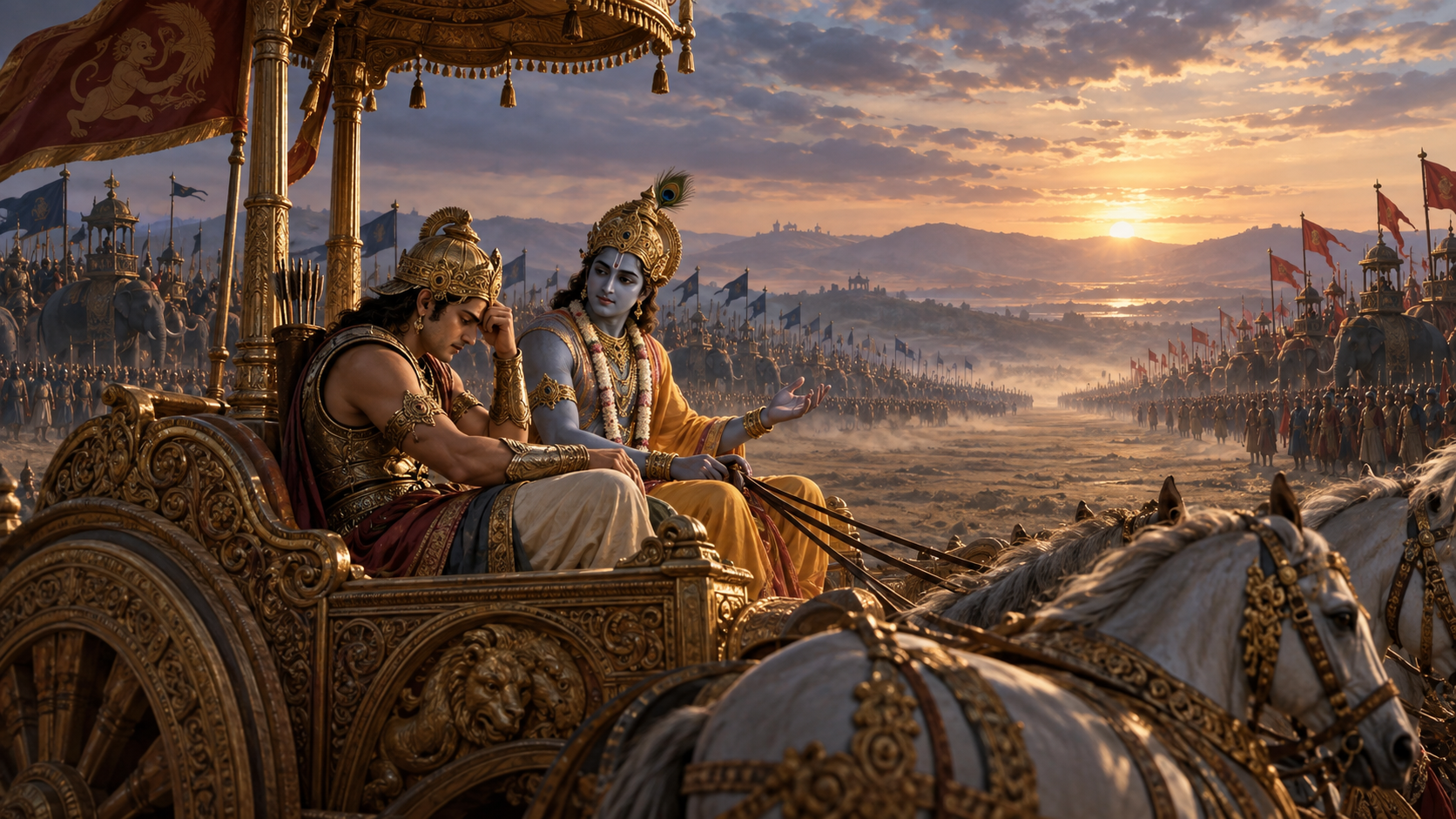
THE ANCIENT STORY
Arjuna wanted to know what happens next.
On the battlefield of the Bhagavad Gita, Arjuna faces a choice whose consequences he cannot predict. Overwhelmed by what might follow, he turns to Krishna for guidance.
Krishna does not promise him control over the outcome. He teaches him to act with care and conviction while releasing his claim on the results.
WHAT CONTROL ASKS OF YOU
Do what is yours. Release what isn’t.
Control becomes exhausting when we confuse influence with ownership. You can prepare carefully, make a thoughtful decision, speak honestly, and do excellent work. What happens after that may still depend on other people, timing, circumstance, or chance.
The challenge is not to stop caring about the outcome. It is to stop making your peace of mind depend on controlling it.
Name what is actually yours.
What decision, action, preparation, or conversation is within your control?
Name what belongs to someone—or something—else.
What outcome are you trying to manage that you cannot ultimately determine?
Act without demanding certainty.
What would you do next if you knew you could choose your action, but not guarantee the result?
Practice
Separate the action from the outcome.
Choose one situation that has been taking up too much mental space. Then divide it into two columns: what is yours to act on, and what is not yours to control.
- What is mine to do?List the choices, actions, preparation, boundaries, or conversations that are genuinely within your control.
- What is not mine to determine?List the responses, timing, outcomes, decisions, or circumstances that belong to other people or to uncertainty itself.
- What can I do next without knowing how it will turn out?Choose one concrete action from the first column and take it without requiring a guaranteed result.
The goal is not indifference. It is to put your energy where it can actually do something.
A FINAL THOUGHT
You were never meant to carry the whole outcome.
You can care deeply, prepare well, and act with integrity without taking responsibility for every result. Sometimes peace begins when you stop asking yourself to control what was never fully yours.